







6 Financial Control Gaps Caused by Manual Reporting

Key takeaways:
- Month-end reporting means decisions get made on numbers that are already weeks old.
- Schools that all use different reporting methods is ultimately the district’s responsibility to solve.
- Late reconciliations are one of the most common reasons districts fail part of their audit, and nearly one in four do.
- If a step isn’t enforced by the system, it gets skipped. Independent verification and second signatures shouldn’t be optional.
- There are three big fixes: consistent processes across schools, an articulated ‘why’ for each process, and financial tools made specifically for K-12.
Managing school finances requires accurate, timely data at every level of your district. When bookkeepers and finance teams rely on spreadsheets and manual processes to track district financial visibility, gaps emerge between what’s happening at each school and what district leadership can see.
KEV Group helps K-12 districts close these gaps with a unified school finance platform. This article breaks down six ways manual reporting creates financial control gaps and what you can do about them.
Quick guide: 6 manual reporting gaps in school district accounting
- Delayed financial data: Reports arrive too late to inform decisions
- Inconsistent record-keeping: Each school tracks funds differently
- Audit trail breakdowns: Missing documentation creates compliance risk
- Reconciliation bottlenecks: Manual matching slows month-end close
- Limited oversight visibility: District leaders lack real-time access
- Error-prone processes: Data entry mistakes go undetected
How we identified these manual reporting gaps
After speaking with hundreds of school bookkeepers, treasurers, and district finance directors, patterns emerged. These are some of the common trends we see when districts rely on manual reporting methods:
- Real-world impact: Each gap directly affects your ability to protect student funds and pass audits
- Frequency: These issues appear across districts of every size, from small rural schools to large urban systems
- Preventability: Every gap can be addressed with the right processes and tools
- Audit relevance: Auditors flag these areas repeatedly in their findings
- Staff burden: Manual workarounds drain time from your finance team
The 6 manual reporting gaps in K-12 school district accounting
1. Delayed financial data creates blind spots
When you only review budget reports at month-end, a lot can happen in 30 days. Spending may already exceed budgets before anyone notices. This delay leaves principals and finance directors reacting rather than planning.
Traditional month-end reporting cycles mean decisions get made with outdated information. By the time reports are finalized, the circumstances that shaped those numbers may have already changed. Districts need current data to manage uncertainty and keep schools financially stable.
Features of delayed data
- Month-end batch processing: Transactions accumulate before anyone reviews them
- Manual report generation: Finance staff must pull data from multiple sources
- Limited drill-down capability: Summaries hide details that matter for decision-making
Delayed data risks
When transactions are simple, low volume, and perfectly documented, delayed data may not cause immediate damage. But over time, it will create problems like these:
- Creates a reactive culture where problems are discovered too late
- Makes forecasting difficult without current numbers
- Increases time spent answering board and stakeholder questions
2. Inconsistent record-keeping across schools
When each school uses its own spreadsheets, naming conventions, and tracking methods, bringing it all together becomes a guessing game. One school might categorize fundraiser proceeds in a spreadsheet. Another might just put totals in an email. These inconsistencies make it hard to compare performance or spot anomalies.
Without standardized categories and workflows, finance teams spend hours reconciling data just to answer basic questions. The lack of uniformity also makes it harder to train new bookkeepers and maintain continuity when staff changes.
Features of inconsistent records
- School-specific tracking: Each building maintains separate tracking methods
- Varied naming conventions: The same fee type might have different labels at different schools
- Decentralized storage: Files live on individual computers rather than shared systems
Risks of inconsistent records
Although inconsistencies give schools flexibility to customize their approach, the costs outweigh this benefit:
- Makes district-wide reporting time-consuming and unreliable
- Increases risk of errors when consolidating data manually
- Creates version-control issues when multiple people edit the same files
In fact, new research shows that record-keeping processes may be even less standardized than previously thought.
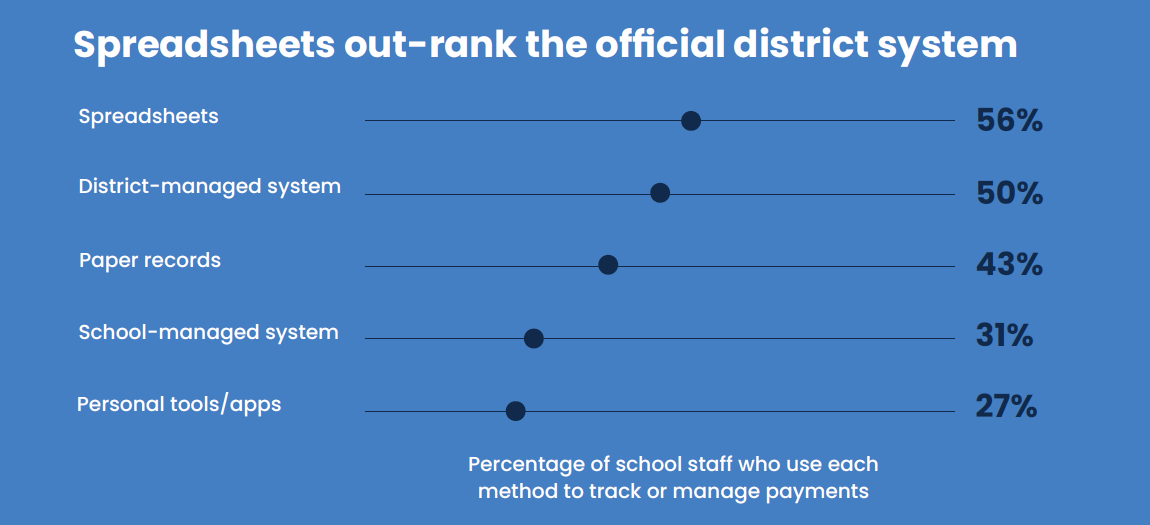
Only half of schools use district-managed systems to manage and track payments.
3. Audit trail breakdowns expose compliance risk
Missing receipts, unsigned approvals, and undocumented hand-offs are audit red flags. When cash and checks pass through multiple hands without proper tracking, auditors cannot verify that funds were handled correctly. Even small documentation gaps signal weak internal controls.
The Government Finance Officers Association makes it clear: oversight and documentation are not optional. Districts that rely on paper-based systems often lack the complete records auditors expect.
Features of broken audit trails
- Paper-based receipting: Physical receipts can be lost, damaged, or forgotten
- Manual approval tracking: Signatures may be missing or impossible to verify later
- Disconnected systems: Payment records don’t link automatically to accounting entries
Damage caused by an audit trail breakdown
The status quo of audit trails is using paper records. Paper is tangible, there’s no tech setup, and staff know how to use it. But long term, it exposes district to additional risk:
- Creates gaps that auditors flag as control deficiencies
- Makes it difficult to reconstruct transaction history when questions arise
- Increases district exposure to fraud when documentation is incomplete
KEV Group’s research shows that 97% of school districts experienced an incident in the past three years. While sometimes minor, these incidents were often serious: one in five districts faced a lawsuit or legal claim and one in five received negative media coverage.
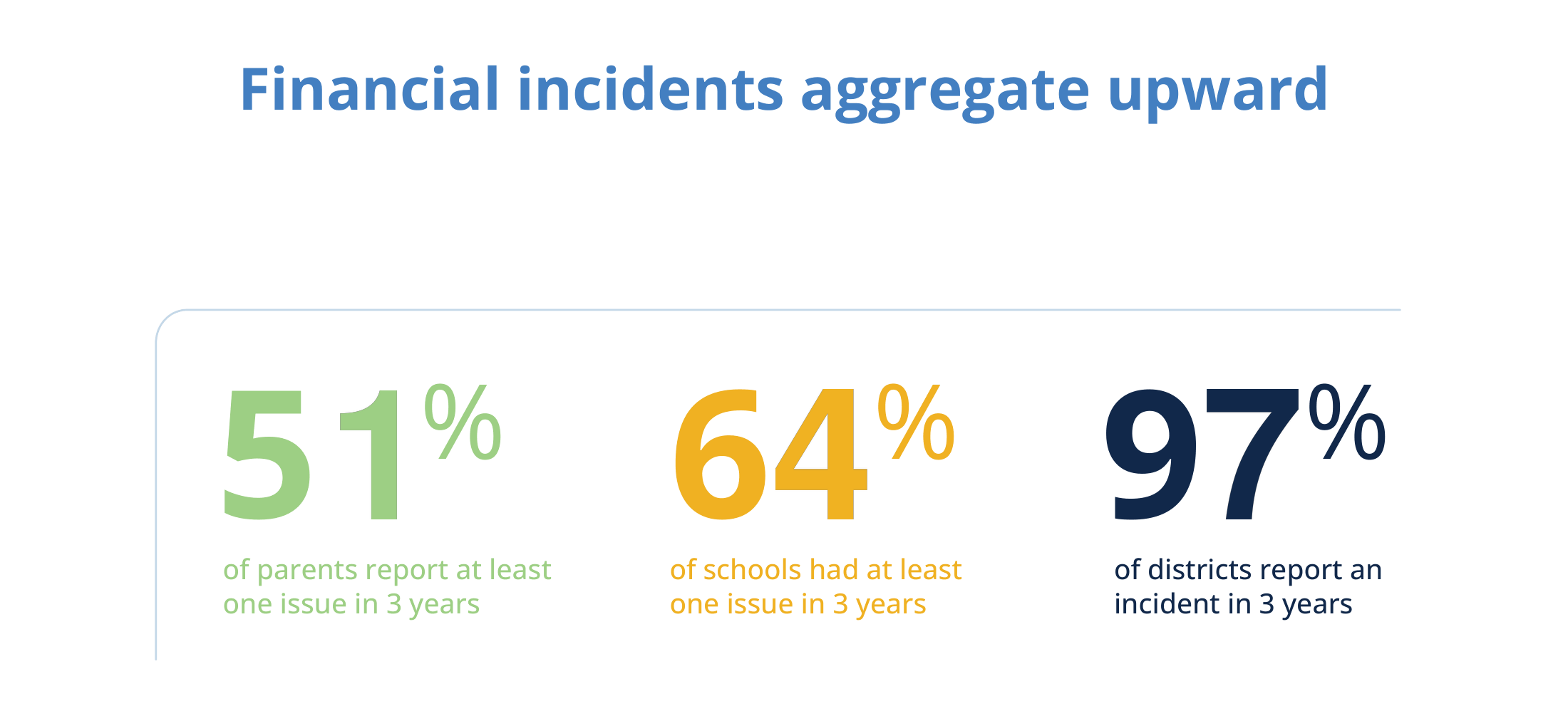
Financial incidents are the norm, not the exception. Broken audit trails make it harder to catch small mistakes before they become serious problems.
4. Reconciliation bottlenecks slow month-end close
Manual reconciliations are one of the most common reasons districts fail audits. Bookkeepers may not fully understand complex account structures, leading to missed items and incorrect balances. The process is slow, error-prone, and often misunderstood.
When reconciliation falls behind, small errors compound into larger problems. KEV Group’s school accounting solution offers guided reconciliation that walks bookkeepers through every step. This standardizes the process across schools and flags discrepancies before they become audit findings.
Features of a bottlenecked reconciliation process
- Manual matching: Staff must compare bank statements to ledger entries line by line
- Multiple data sources: Information must be pulled from different systems
- Limited visibility: District finance cannot easily see which schools have completed reconciliation
Reconciliation bottleneck risk
- Late reconciliations can trigger audit failure
- Easy to manipulate, making it harder to distinguish mistakes from intentional concealment
- Takes significant time away from other finance responsibilities
5. Limited visibility for district leaders
When financial information lives exclusively in school offices, district leaders can’t answer basic questions without requesting reports from each building. This creates delays when the board asks about fund balances or when concerns arise about specific transactions.
Principals and department managers often ask questions like How much money is left in my budget? and Have these invoices been paid? If the finance department must create custom reports for every inquiry, valuable time is lost. Better financial visibility means everyone can access the information they need when they need it.
Features of low visibility
- School-level data silos: Each building holds its own records
- Request-based reporting: Leaders must ask finance staff for updates
- No real-time dashboard: Current balances require manual lookups
Limited visibility risks
- Delays board responses and strategic decisions
- Puts extra burden on finance staff to generate ad hoc reports
- Reduces accountability when leaders cannot see spending in real time
6. Poorly defined processes
Every manual step introduces the possibility of error. Data entry mistakes, transposed numbers, and misclassified transactions are common when staff must key information into multiple systems. And with many systems, steps like independent verification or multiple signatures are optional rather than enforced. And if a step isn’t enforced by the system, it will get skipped. These errors and omissions are often discovered only during audits or when balances don’t match.
Manual processes are also easier to manipulate. Creating fake journal entries or altering digital records is far too simple when systems lack controls. Automated posting and immutable transaction records help districts catch errors early and prevent intentional misuse.
Features of poor processes
- Redundant data entry: The same information must be entered in multiple places
- No automated validation: Errors aren’t flagged until someone manually reviews reports
- Editable records: Past entries can be changed without leaving a trace
- No system-level enforcement: Important steps are optional and skippable
Poor process risks
If there’s any upside to poor processes, it’s flexibility. But if staff can quickly make corrections without approvals, it means they can also make errors without oversight. The tradeoff is rarely worth it, especially with downsides like these:
- Increases risk of undetected fraud through manipulated entries
- Creates discrepancies that take time to investigate
- Erodes confidence in financial reports when stakeholders find mistakes
The solution to all 6 control gaps: KEV Group School Finance Platform
KEV Group gives districts complete financial visibility by unifying payments, school accounting, and reporting in one system. Instead of piecing together information from spreadsheets and disconnected tools, you see every transaction as soon as it happens.
The platform tracks every dollar from the moment it’s collected through deposit, reconciliation, and reporting. This means bookkeepers spend less time on manual data entry and more time on meaningful oversight. District finance teams gain a single source of truth across all schools.
According to KEV Group’s analysis, nearly one in four K-12 school districts fail some portion of their financial audit. Most failures trace back to fixable problems related to manual processes and weak internal controls.
KEV Group features
- Automatic transaction posting: Every payment posts directly to the correct GL account without manual re-entry
- Real-time reconciliation: Guided workflows help bookkeepers complete reconciliations accurately and on time
- District-wide reporting: Over 50 pre-built reports give you visibility from student-level detail to district summaries
- Complete audit trail: Every hand-off and transaction is time-stamped and traceable
- ERP and SIS integration: Connects with your existing systems to eliminate duplicate data entry
KEV Group pros and cons
Pros:
- Reduces manual work by automating payment posting and reconciliation
- Trusted by 28,000+ K-12 schools across North America
- The strongest security possible, protecting important funds and data
- Built specifically for K-12 school finance workflows by educators who understand your challenges
Cons:
- Initial implementation requires data migration and staff training
- Full benefits require consistent use across all schools in the district
- Some advanced reporting features may need additional configuration based on your district’s structure
Comparison table: Manual reporting gaps in school district accounting
Change is hard, but when manual reporting gaps are creating serious risk for the district, it’s time to evaluate a better solution for managing K-12 school activity funds.
|
Approach |
Real-Time Visibility |
Automated Posting |
Complete Audit Trail |
|
KEV Group |
✓ |
✓ |
✓ |
|
Delayed Data |
✗ |
✗ |
✗ |
|
Inconsistent Records |
✗ |
✗ |
✗ |
|
Audit Trail Breakdown |
✗ |
✗ |
✗ |
|
Reconciliation Bottleneck |
✗ |
✗ |
Partial |
|
Limited Oversight |
✗ |
✗ |
Partial |
|
Error-Prone Processes |
✗ |
✗ |
✗ |
What steps can districts take to strengthen internal controls?
Building strong financial controls starts with standardizing processes across every school. When all buildings follow the same workflows for receipting, depositing, and reconciling funds, oversight becomes possible and gaps become visible.
The training matters as much as the technology. Bookkeepers need clear expectations about deposit timeframes, documentation requirements, and approval processes. Regular training helps staff understand why controls exist and how to follow them consistently.
Investing in purpose-built K-12 finance tools makes a measurable difference. Systems designed specifically for school payment and fee management reduce manual work, create complete audit trails, and give district leaders the visibility they need to catch issues early.
How does automation improve district financial visibility?
Automation eliminates the gaps between when money moves and when leadership knows about it. When payments post automatically to the correct accounts, there’s no delay waiting for manual entry. Finance teams see transactions the moment they happen.
Automated systems also enforce consistency. Every school uses the same categories, the same approval workflows, and the same reconciliation processes. This standardization makes district-wide reporting accurate and reliable, without hours of manual consolidation.
The result is confident decision-making. When you trust your numbers, you can respond quickly to board questions, spot budget variances before they become problems, and demonstrate compliance during audits. Districts using KEV Group report reduced cash handling, faster reconciliation, and improved audit readiness across their schools.
Why KEV Group is the leading school finance platform for K-12 districts
KEV Group closes the financial control gaps that manual reporting creates. The platform unifies payments, accounting, and reporting so you see every dollar across every school. This visibility is what separates districts that pass audits confidently from those that scramble at year-end.
Built specifically for K-12 by people who understand school finance, KEV Group addresses the real challenges bookkeepers and district finance teams face. From automatic payment posting to guided reconciliation to complete audit trails, the platform handles the work that manual processes make difficult.
Trusted by 26,000+ K-12 schools and processing billions in payments annually, KEV Group has proven its value across districts of every size. When you’re ready to replace spreadsheets with real financial visibility, KEV Group delivers the control your district needs.
FAQs about manual reporting gaps in school district accounting
What are the biggest financial control risks in K-12 school districts?
The biggest risks come from weak internal controls, excessive cash handling, and manual processes that lack proper documentation. KEV Group’s analysis shows that 68% of K-12 fraud incidents occur at the school level, where controls are typically weakest. Addressing these gaps requires standardized processes and real-time oversight.
How does manual reporting affect audit outcomes?
Manual reporting leads to delayed reconciliations, missing documentation, and inconsistent records, all of which auditors flag as control deficiencies. Nearly one in four K-12 districts fail some portion of their audit, often due to problems that automated systems would prevent. KEV Group helps districts maintain audit-ready operations year-round.
What should school bookkeepers prioritize to improve financial controls?
Focus on timely reconciliation, consistent documentation, and following district-approved processes. Every cash collection needs a receipt, every deposit should happen within established timeframes, and every approval should be documented. KEV Group’s guided workflows help bookkeepers complete these tasks accurately and on schedule.
How can districts improve budget visibility without replacing their ERP?
Many districts enhance their existing ERP with reporting and dashboard solutions that fill the school-level visibility gap. KEV Group integrates with your current systems to unify fee management, payments, and accounting data. This gives district leaders real-time access to school financial activity without replacing core infrastructure.
What documentation do auditors expect for student activity funds?
Auditors expect complete records showing how funds were collected, deposited, approved, and spent. This includes receipts, deposit slips, approval signatures, and reconciliation reports. KEV Group automatically tracks every transaction and hand-off, creating the digital audit trail that demonstrates proper oversight.
Get the latest K-12 finance best practices delivered to your inbox.
Recommended For You