







The School Finance Blind Spot: Inside the Hidden Gap Putting K–12 Schools at Risk

What if the biggest financial risk facing public schools wasn’t a budget cut or a data breach — but something happening inside your buildings every day?
Across North America, K–12 districts are navigating uncertain funding, complex policy landscapes, and rising expectations from families who demand transparency for how public funds are used.
Yet a critical vulnerability continues to fly under the radar: a lack of real-time visibility into how money is collected, handled, and managed inside individual schools. This school finance blind spot is costing districts millions, eroding community trust and ultimately taking resources away from students.
To understand the scope of the issue, we analyzed 93 verified school fraud cases that occurred between 2024-2025 in our new K-12 Fraud Report. Below are key findings from our analysis and steps district leaders can take to protect their schools from becoming the next news headline.
Key Takeaways
- K–12 districts have a financial “blind spot”. Limited visibility into school-level funds creates risk, even when district-level controls are strong.
- Most fraud happens at the school level. Weak oversight, manual processes, and decentralized systems make individual schools more vulnerable than central offices.
- Digital payment misuse increases exposure. Unapproved payment apps and inconsistent tracking reduce transparency and can lead to significant losses.
- Closing the gap requires visibility and control. Standardized processes, strong internal controls, and purpose-built K–12 finance systems help protect funds and maintain community trust.
The School Finance Blind Spot, Explained
While almost every district has financial controls in place, not every school does.
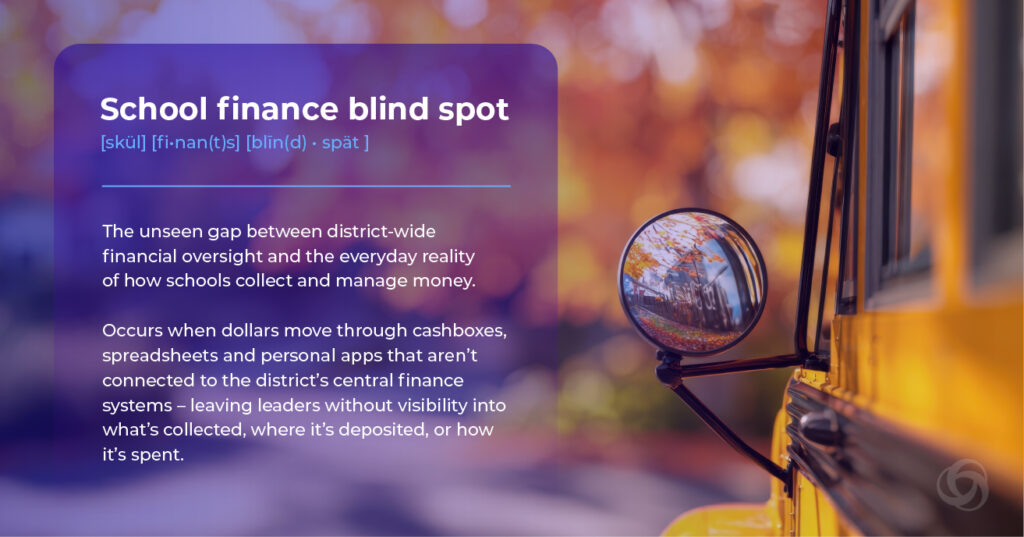
This creates a school finance blind spot — a critical oversight gap between district-level financial systems and the everyday realities of how money moves within schools.
And the consequences are real: our analysis shows $49 million was lost across 93 confirmed fraud cases, much of it involving school-level activities that rely on trust-based systems, manual processes, and fragmented tools.
This is why transparency is the new currency of trust for school communities. Parents expect to see where money goes. Staff expect systems that protect them. And districts need visibility to safeguard resources. But when school finance processes depend on trust alone — rather than transparent, traceable systems — small visibility gaps can quickly snowball into widespread issues.
Three Signals K–12 Leaders Can’t Ignore
From our analysis, three patterns emerged that district leaders can’t afford to overlook.
1. The majority of fraud happens inside schools — not at the district office
Our analysis revealed that 68% of fraud incidents occur at the school level, where financial controls and dedicated finance systems are not yet in place. This is twice the rate of district-office fraud and highlights a reality many leaders know firsthand: schools manage large volumes of money using processes and tools that weren’t designed for K–12.
2. Nearly all fraud is committed by people we trust
A staggering 97% of cases involve internal staff or volunteers — bookkeepers, coaches, secretaries, PTA members, and others operating without real-time oversight or standardized processes.
This underscores a critical issue: it’s often good people making poor decisions under pressure, and in environments where weak or missing controls can create temptation.
3. Digital payments create new risks… and bigger losses
62% of fraud involves cash. But while only 10% of fraud causes in our analysis involved peer-to-peer payment apps, those incidents accounted for 77% of all losses. When personal PayPal, Cash App or Venmo accounts are used in place of district-approved tools, visibility disappears and risk grows exponentially.
Why K–12 Fraud Happens: A Perfect Storm from a Lack of Training and Process Gaps
School fraud rarely results from a single failure — it emerges from a combination of risk points:
- Decentralized authority: Many people handle money, but few have formal financial training.
- Outdated processes: Paper receipts, manual reconciliations, and informal collection practices are still the norm for many schools.
- Multiple collection points: Field trips, athletics, fundraisers, arts programs — each type of school activity creates opportunities for unmonitored transactions.
- Limited monitoring: District enterprise resource planning (ERP) systems keep central finances tight, but school-generated funds often fall outside of those systems.
These challenges aren’t new, but the stakes have never been higher. Tighter budgets, uncertain federal funding landscape and communities demanding accountability from the institutions they support.
The True Cost of School Fraud: Students Pay the Price
While the $49 million lost is alarming, the financial loss and reputational damage is only part of the story. Each incident diverts time and resources away from supporting student outcomes. And because these losses are often uncovered months or years later, the damage — both financial and reputational — has already compounded.
When parents donate to fundraisers or pay activity fees, they trust that money will benefit their children’s education. When fraud happens, that trust is broken — and the ripple effect is felt long after the money is gone.
Financial transparency safeguards not just dollars, but the relationship between school and community members.
The Path Forward: Stronger Systems and Modern School-Level Controls
Here’s the encouraging news: school-level fraud is preventable.
Districts that implement purpose-built school finance platforms — connecting accounting, payments, reporting, and audit trails — are eliminating fraud risk while streamlining operations.
The path forward includes:
- Clear checks and balances at both district and school levels
- Real-time visibility into all school-generated funds
- Standardized procedures that protect both staff and students
- Centralized digital tools designed for how schools operate
Modern systems don’t replace trust — they reinforce it with transparency, consistency, and accountability. And as family expectations evolve, this combination of trust and transparency becomes essential for maintaining community confidence in public education.
Get the 2025 K–12 Fraud Report
The 2025 K-12 Fraud Report offers detailed analysis, case studies, and actionable recommendations to help districts eliminate blind spots and protect school funds.
Explore the full report to understand where districts are most vulnerable — and what steps leaders can take now to strengthen financial transparency, accountability, and community trust.
Get K-12 finance insights delivered to your inbox.
Recommended For You