








When and Why Districts Outgrow Ad Hoc Financial Support

Key takeaways:
- Disconnected finance tools create blind spots that hide risk and weaken audit readiness across your district.
- Finance teams using fragmented systems spend more time gathering data than building strategy.
- Inconsistent adoption of multiple platforms means your reporting is only as accurate as your weakest school.
- KEV Group unites payments, school accounting, and reporting in a single platform built for K-12 operations.
- Recognizing these warning signs early lets your district move from reactive fixes to strategic financial management.
A district with 30 schools might rely on five different tools to collect fees, track activity funds, and reconcile payments. One app for online payments at the high school. A different login for the elementary lunch program. Spreadsheets for the booster club.
Each tool works fine on its own, until the district finance office tries to pull a consolidated report and nobody’s numbers match. That patchwork approach to school finance software creates real operational problems.
KEV Group has worked with more than 28,000 schools and found that 64% of districts use three to five disconnected systems for school-level payments alone. This article walks through the warning signs that your district has outgrown fragmented finance support.
Key Takeaways: Why Districts Outgrow Patchwork Finance Support
- Disconnected finance tools create blind spots that hide risk and weaken audit readiness across your district.
- Finance teams using fragmented systems spend 85% of their time gathering data instead of building strategy.
- Inconsistent adoption of multiple platforms means your reporting is only as accurate as your weakest school.
- KEV Group unites payments, school accounting, and reporting in a single platform built for K-12 operations.
- Recognizing these warning signs early lets your district move from reactive fixes to strategic financial management.
Warning Signs Your District Has Outgrown Fragmented Finance Support
1: Your Finance Team Spends More Time Collecting Data Than Analyzing It
When staff members pull numbers from three or four systems just to build one report, that is a structural problem, not a people problem. A 2025 K-12 Business Leaders Pulse Check survey found that 47% of district CFOs spend more than 100 hours each year preparing for audits, and 70% still depend on manual processes.
Those hours come directly out of time your finance team could spend on forecasting, budget analysis, or year-round audit preparation. If data-gathering dominates your team’s calendar, the systems are the bottleneck.
2: No Single Person Can Tell You How Much Money Flowed Through Your Schools Last Month
This is the visibility gap. Your ERP tracks district-level totals. Your SIS manages student records. Neither one captures the daily flow of cash, checks, and card payments at the school level. Field trip deposits, spirit wear sales, and fundraiser income often live outside your core financial systems entirely.
Many CFOs have systems (or think they do) that can show them all of this in an integrated way. But when you dig deeper and ask them about their systems’ limitations, the cracks begin to show.
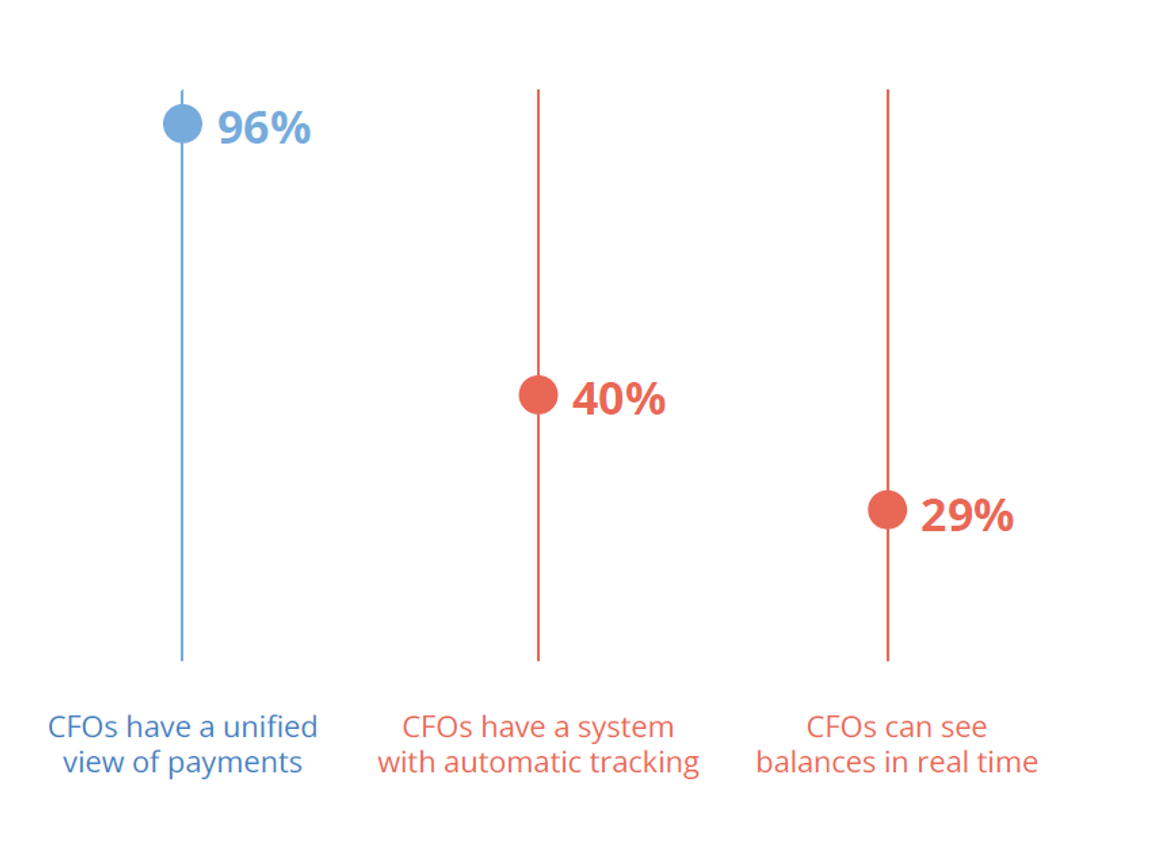
Most CFOs think they have a unified view…but fewer than a third have a view that’s real time.
3: Different Schools Use Different Tools, and Adoption Is Uneven
One school uses the district-approved payment system. Another collects cash and tracks it in a notebook. A third relies on a free app a parent volunteer set up two years ago. Each approach creates its own data silo, its own reconciliation process, and its own risk profile.

Inconsistent adoption means your district’s reporting is only as accurate as your least-compliant building. When audit season arrives, gaps at one school can trigger findings that reflect on the entire district. That uneven footprint is a structural gap, not an individual failure.
4: Reconciliation Takes Days Instead of Minutes
Manual reconciliation is one of the clearest signs that patchwork finance support has run its course. When bookkeepers log into separate platforms, export files in different formats, and cross-reference totals by hand, errors multiply. A missed deposit here, a duplicate entry there, and the month-end close stretches into days.
A unified school finance platform eliminates that cycle by posting every payment directly to the correct GL account and bank deposit in real time. School-level accounting becomes a daily function, not a monthly ordeal.
5: Your Audit Trail Has Gaps You Cannot Explain
If your auditor asks for a transaction history and your team has to reconstruct it from emails, bank statements, and paper receipts, the system has failed its most basic job. A K-12 Financial Maturity Curve analysis shows that districts at earlier maturity stages often lack a digital audit trail.
Every transaction, from the moment a parent pays a fee to the moment it posts to the general ledger, should be tracked and time-stamped automatically. Gaps in that trail increase audit risk and erode the trust your board and community place in your financial reporting.
6: You Cannot Track a Single Payment From Collection to GL Posting
End-to-end traceability is the benchmark. If a fee is collected online but the posting to your general ledger requires a manual journal entry three weeks later, you have a control gap. That gap exposes your district to errors, delayed reporting, and potential compliance findings during your next audit cycle.
KEV Group’s School Cash platform connects every payment to the correct student, item, and account automatically. From payment to posting, each transaction is receipted, tracked, and visible at both the school and district level.
7: Adding a New School or Program Means Adding Another Tool
Growth should not mean more complexity. Yet many districts discover that each new school, program, or fundraiser requires a separate app, login, or process. Over time, this accumulation creates what KEV Group calls the ERP gap.
That gap is the space between what your enterprise systems were built to manage and what actually happens at the school level. A purpose-built school finance platform scales with your district. New schools get the same workflows, controls, and reporting on day one.
8: Your Staff Turnover Compounds the Problem
When a school bookkeeper retires or moves on, the institutional knowledge of how to operate three different finance tools walks out the door with them. New hires face a learning curve unique to each building, because each building runs a different combination of platforms and processes.
Standardizing on a single system means every bookkeeper follows the same workflows, uses the same integrations, and accesses the same training materials. Onboarding becomes predictable, and your district retains operational continuity regardless of who sits in the chair.
How a Unified School Finance Platform Closes the Gap
The warning signs above share a common root cause. Fragmented tools were never designed to give your district full visibility and control over school-level finances.
ERPs manage payroll and district accounting. SIS platforms manage student records. Neither was built to capture, receipt, reconcile, and report on the millions of dollars flowing through individual schools each year. KEV Group’s School Cash platform fills that gap by uniting fee management, payments, school-level accounting, and district-wide reporting in one system.
For districts ready to move beyond patchwork fixes, the first step is honest evaluation. KEV Group’s financial health assessment helps you identify exactly where your district stands and what it takes to reach audit-ready financial operations.
Want to know your district’s risk? Take our free K-12 Financial Maturity Assessment
FAQs
What is patchwork school finance software support?
Patchwork support happens when a district uses multiple disconnected tools for payments, accounting, and fee management at the school level. Each tool handles one task but none of them communicate with each other, creating gaps in reporting and audit readiness.
How do fragmented finance systems increase audit risk?
When transactions flow through separate platforms, the audit trail breaks. Auditors cannot verify a payment’s full journey from collection to GL posting without manual reconstruction. KEV Group eliminates that risk by tracking every transaction in one system from start to finish.
What role does an ERP play in school-level finance?
Your ERP manages district-level accounting, payroll, and budgeting. It was not built to capture daily school-level transactions like activity fund deposits, lunch payments, or fundraiser income. A purpose-built school finance platform works alongside your ERP to close that gap.
How does a unified platform reduce the impact of staff turnover?
A single system means every school follows the same workflows, training materials, and reporting processes. New bookkeepers learn one platform instead of a building-specific combination of apps and spreadsheets. Onboarding becomes consistent and faster across your district.
Can districts keep their existing ERP and SIS with a unified finance platform?
Yes. KEV Group’s platform integrates directly with your existing ERP and SIS. Student data syncs automatically for fee assignment, and financial totals roll up to your district chart of accounts. The platform adds real-time visibility at the school level without replacing your core systems.
What is the first step toward replacing patchwork finance tools?
Start by listing every tool used across your schools for payments, accounting, and reporting. Note contract end dates and costs. If you count more than three or four systems, consolidation will likely improve both visibility and control. KEV Group’s financial maturity assessment can help you pinpoint where to begin.
Get the latest K-12 finance best practices delivered to your inbox.
Recommended For You