

How a school can lose $3 million in 10 seconds

Key Takeaways
- K-12 finance losses can happen in seconds when vendor payment workflows rely on email threads, invoice PDFs, or manual banking updates instead of verified, system-controlled records.
- Districts are most exposed when school payments, vendor management, integrations, paper processes, and cash handling operate as a patchwork with no unified audit trail.
- A more secure 2026 school finance model depends on consolidation, verified vendor management, dual controls, encryption/tokenization, strong compliance standards, and a narrow third-party footprint.
It only takes about ten seconds to lose three million dollars. That’s the gap between clicking “send” on a wire transfer and the money landing in an account you’ll never see again.
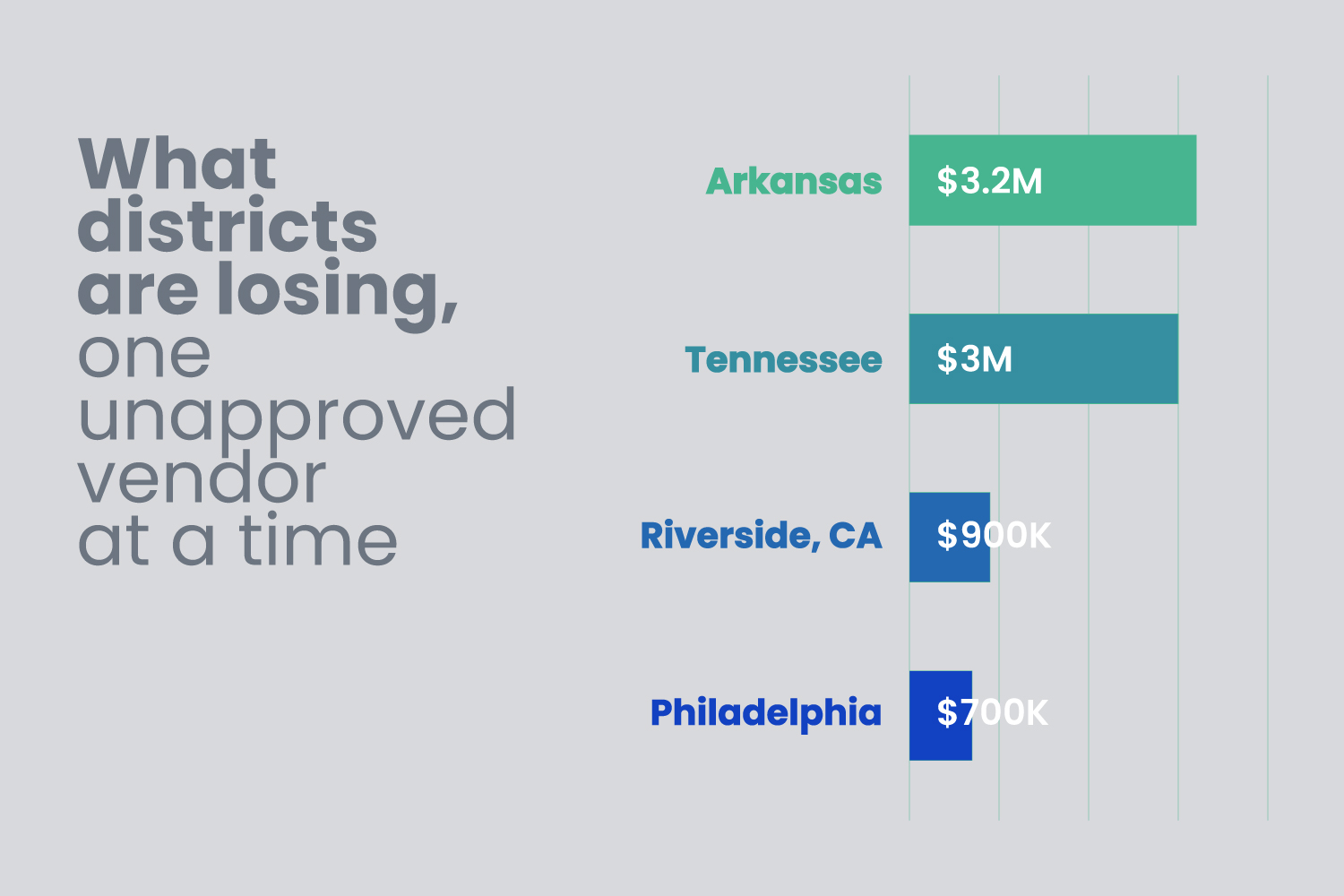
A school district in Arkansas lost $3.2 million to school district wire fraud. The wire was for a legitimate construction project and the instructions arrived inside a real email thread with a real vendor. Same signatures, same formatting, just updated banking details. The vendor’s email had been compromised. By the time anyone noticed, the money was gone.
A pattern, not an isolated incident
It’s not an isolated case. A district in Tennessee lost $3 million the same way. Philadelphia lost $700,000. Riverside, California lost over $900,000. The mechanics of school district wire fraud are always the same: an attacker compromises or impersonates a trusted vendor, waits for a real invoice cycle, and sends updated banking details that look exactly like every other email in the thread. The finance officer clicks send. The money is gone.
This is happening at school districts across North America right now. And it’s costing them more than any of the high-profile data breaches you’ve been reading about.
Why this keeps happening: the patchwork
Most districts collect fees from thousands of families and pay hundreds of vendors a year. These are the risks that don’t make headlines.
Think about what payment collection looks like in a typical district. Some fees come in through the student information system. Some come through a separate payment processor for lunch accounts. Field trip money might be collected in cash by teachers or the front office.
On the outbound side, the picture is similar. Vendor banking information often lives in an email thread, an invoice PDF, or a filing cabinet.
This is the patchwork. No single person can draw a complete map of where money enters, leaves, or sits at any given moment. And it creates three major security problems:
Each piece has its own security posture, and most weren’t built for 2026. A parent portal designed several years ago was not built as a pinnacle of cybersecurity. And cash in a classroom envelope is its own kind of risk. Not from external attackers, but from the absence of any audit trail at all. Analog isn’t safer; it’s untracked.
Integration points are doors. When two systems exchange data, the connection becomes part of the attack surface. A 2024 breach that affected 62 million people happened because attackers got into a support tool, then moved through it to the customers’ SIS. The recent vendor breaches followed the same pattern.
Patchworks make incident response brutal. When something goes wrong in a consolidated system, you know what was touched and when. When something goes wrong across fifteen tools, three integrations, and a stack of paper, the investigation alone can take months. When a large South Carolina district was hit by ransomware in June 2025, they were facing a class-action lawsuit by September, alleging delayed notification and inadequate cybersecurity practices.
The risks are real. So are the damages.
The same pattern, one level up
This same pattern shows up at the vendor level, too. And that’s the part of the story that’s been making headlines.
Three of the largest education technology vendors in North America just disclosed major data breaches. They included:
- A K-12 student information system used by 11 million students
- A learning management platform used by nearly 9,000 institutions
- A textbook publisher whose products sit on the shelves of every school district in North America
These breaches share a pattern. The attacker didn’t break the vendor’s product. They broke a third-party platform the vendor used to run its own business. In some cases, an employee’s Salesforce account. In another, they exploited a vulnerability in Oracle’s E-Business Suite.
This matters because it tells you what to actually look for when you evaluate any vendor. What matters most are questions like these:
What security and compliance credentials do you maintain? For full protection, you’ll want SOC 2 Type II compliance and to ensure the vendor is a PCI DSS Level 1 Service Provider. Anything less leaves real gaps.
How fast is your incident response? In one of the recent education data breaches, customers waited weeks for full disclosure. But in most cases, vendors had public statements out within 48 hours. That gap matters.
What’s the blast radius of an employee account? If a single Salesforce login can leak names and addresses for millions of students, that’s a problem.
What “secure” looks like for K-12 finance in 2026
If you’re evaluating new student activity fund management platforms or auditing your current security, these are the dimensions that separate robust systems from patchwork ones.
Consolidation. How many of the touchpoints between money and your district can live inside a single, audited platform? The fewer separate systems, the smaller the attack surface and the cleaner the audit trail.
Verified vendor management. Trusted vendors should be added through authenticated workflows inside the system. That way, when someone cuts a cheque, the vendor’s information pre-populates from a trusted record instead of being copied from a random invoice in someone’s inbox.
Dual control as a default, not a workaround. In a perfect world, your system requires two approvers for important approvals and payments. It’s platform-enforced, not just a suggestion that can be skipped.
Encryption and tokenization for sensitive data. Payment card data, bank account details, and student-linked financial information should be encrypted. Check your vendors’ compliance and security records, including PCI DSS Level 1 and SOC 2 Type II.
A narrow third-party footprint. This will help prevent data breaches like the ones in the news. Every modern platform depends on other platforms. But your vendor should know exactly what those dependencies are and actively monitor them.
If you’re still looking at different tools, our School Finance Buyer’s Guide will guide you through every step of the process.
The takeaway
The vendor breach headlines and ransomware attacks aren’t going anywhere. But the most exposed to school district wire fraud in 2026 are those still running on disconnected products, with a cash box in every office.
The shift that matters is reducing patchwork, strengthening integrations, and consolidating the points where money enters and leaves the district.
It’s a difficult shift. But it’s the only one that materially changes the picture for school finance risk.
Get the latest K-12 finance best practices delivered to your inbox.
Recommended For You